
The Michigan Education Guarantee
A new graduation standard ensuring every Michigan student graduates ready for college, career, and life.
Quick Navigation
-
The framework behind the guarantee.
-
Want to learn more about the MEG in action? Check out our MEG Playlist. Listen to the podcast, watch a webinar, or read a one-pager.
-
-
Join our newsletter. Keep an eye on opportunities to share feedback and participate in MEG co-design events.

Why Michigan Needs the MEG
The world is changing. Why shouldn’t high school?
73%
of Michigan students are not meeting readiness benchmarks.
30%
of Michigan high school students are chronically absent from school.
89%
of Michigan employers surveyed agree that real experiences have the most educational value.
Michigan Education Guarantee: Progress

Initial Research
Graduation Standard Workgroups


Pilots and Implementation
Graduation Standards Framework
Policy Development

From Graduation Requirements to a Graduation Standard:
The Necessary Components
-
The MEG intentionally redesigns the four years of high school so that students build a strong foundation and gain greater flexibility as they demonstrate readiness.
Grades 9–10: Students focus on building foundational academic skills, disciplinary knowledge, and durable skills while beginning career exploration. Learning can occur through coursework and other experiences aligned with the student’s EDP.
By the end of Grade 10: Students complete a statewide-comparable Mastery Check of foundational reading, writing, and mathematical reasoning. The purpose is to identify whether students have the needed foundational skills and to provide timely support when they do not.
Grades 11–12: Students have greater flexibility to pursue advanced coursework, dual enrollment, work-based learning, apprenticeships, career and technical education, early or middle college, and other experiences aligned with their EDP while continuing to demonstrate the skills required for graduation.
This creates a high school experience that becomes more personalized as students demonstrate they are ready for greater independence and deeper learning. Some students may follow a traditional course sequence; others may build a more customized pathway. The expectation for mastery remains rigorous for every student.
-
Every student develops an Educational Development Plan (EDP) beginning in Grade 7 that connects their career interests and goals to their education. The plan is reviewed regularly with each student and family and supported by high-quality college and career advising so that it actively guides course choices, career experiences, and postsecondary planning.
A strong EDP should help students understand their interests, connect those interests to real economic opportunities, and identify the postsecondary education, training, credentials, and experiences that can help them reach their goals. It should be a living plan—not a compliance document.
The EDP can also serve as a place to organize evidence of learning, career-focused experiences, a professional résumé, and other milestones that help students prepare for what comes next.
-
The MEG establishes clear statewide expectations for what every Michigan graduate should know and be able to do, while giving students and schools greater flexibility in how students get there.
Students demonstrate mastery across three broad areas:
Foundational Academic Skills: Reading, writing, and mathematical reasoning aligned to state academic content standards.
Disciplinary Literacies: The knowledge and ways of thinking students develop through science, social studies and civics, finance and economics, health and wellness, world languages, and the fine, performing, and visual arts.
Durable Skills: Transferable skills such as communication, collaboration, critical thinking, creativity, problem solving, and leadership that students need in college, career, and life.
Students can develop these skills through many different learning experiences, including traditional and advanced coursework, project-based learning, community-based learning, dual enrollment, internships, apprenticeships, career and technical education, and work-based learning. Districts retain flexibility in how they organize these opportunities and how students demonstrate mastery.
-
In the MEG, mastery means students earn credit by demonstrating what they know and can do, rather than simply completing a required course or amount of seat time. Students can build and demonstrate mastery through coursework as well as projects, portfolios, career-focused education, work-based learning, dual enrollment, and other experiences inside and outside the traditional classroom.
A Mastery Check by the end of Grade 10 ensures students have the foundational reading, writing, and mathematical reasoning skills they need, so they can spend more of Grades 11 and 12 pursuing personalized, career-connected learning aligned with their goals and interests.
The Mastery Check should be statewide-comparable and designed to answer a straightforward question: has the student developed the foundational academic skills needed to successfully pursue the next stage of high school and life after graduation? Students who need additional time or support should receive it and have additional opportunities to demonstrate mastery. Students with disabilities should have appropriate accommodations and individualized ways to demonstrate learning consistent with their educational plans.
Beyond foundational academics, students demonstrate mastery of disciplinary literacies and durable skills through multiple measures and learning experiences. The MEG is intentionally less prescriptive about any single assessment or method of demonstration; the goal is a credible body of evidence that shows what a student knows and can do.
-
Michigan’s education system is still largely built around a century-old assumption that learning is measured by how much time a student spends sitting in a classroom. The MEG modernizes that system by recognizing that meaningful learning can also happen in workplaces, colleges, training programs, communities, online environments, and through hands-on projects and experiences.
Michigan’s pupil accounting, instructional-time, and credit rules should be redesigned to support these opportunities while maintaining strong accountability for student learning and public resources. Districts should have flexibility to organize the school day and year in ways that support student learning rather than being constrained by seat-time rules that were designed for a different era.
-
Career exploration and preparation become part of every student’s education, instead of something reserved only for students enrolled in traditional career and technical education programs.
Students participate in a sequence of career-focused learning and experiences beginning in middle school and continuing through high school. Depending on student interests, local opportunities, and the EDP, these experiences can include career exploration, job shadows, work-based learning, internships, apprenticeships, dual enrollment, industry credentials, project-based learning, career simulations, and other experiences that connect academics to the real world.
The goal is not to require every student to follow the same career pathway. It is to ensure every student has enough meaningful exposure and experience to make informed decisions about what comes next and to graduate with the skills and tools—including a professional résumé—needed to pursue those goals.
-
Greater flexibility cannot mean lower expectations or fewer opportunities for some students. Schools and districts should regularly examine participation, access, and outcomes to ensure students of different backgrounds have equitable access to advanced coursework, career-connected learning, dual enrollment, work-based learning, and other personalized pathways.
The state should use this information to identify gaps, provide support, and ensure that greater flexibility expands opportunity rather than creating new forms of tracking. Accountability should focus both on whether students have access to high-quality opportunities and whether they ultimately demonstrate the knowledge and skills required for graduation.

Resources

The MEG Playlist
The Michigan Education Guarantee is a broad promise, but there’s already great work in action across our state as well as excellent research to learn from in other states throughout the nation. Keep an eye here for up-to-date resources on the MEG.
Spotlight: Innovation in Action
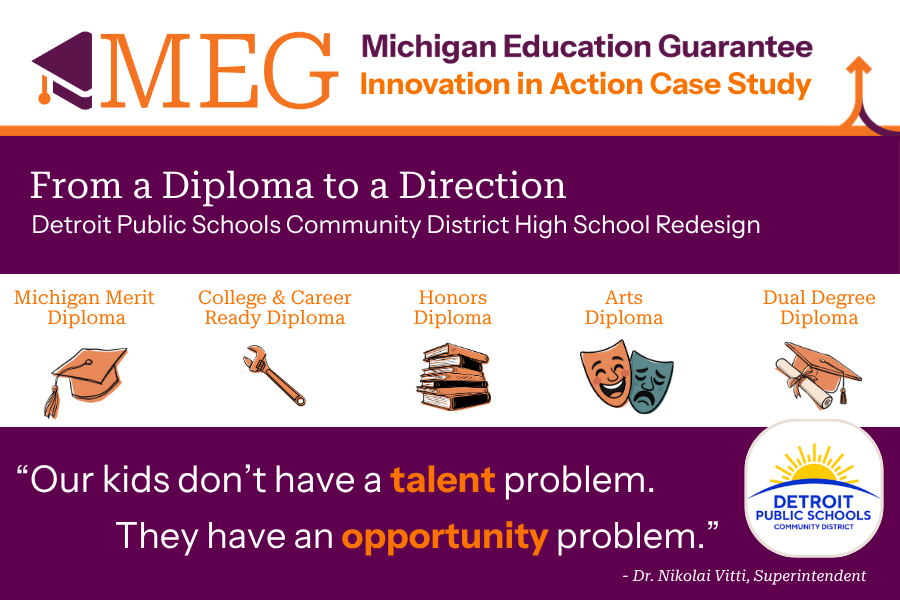
Detroit Public School Community District High School Redesign
Read the one-pager
For an easy-to-read and share breakdown of the DPSCD high school redesign, check out this one pager.
Listen to Dr. Vitti on the Launch Michigan Podcast
On Episode 2, Dr. Nikolai Vitti shared more about the process and specifics of DPSCD’s high school redesign. Listen here.


Videos and Podcasts featuring more about the MEG

Reciprocal Accountability
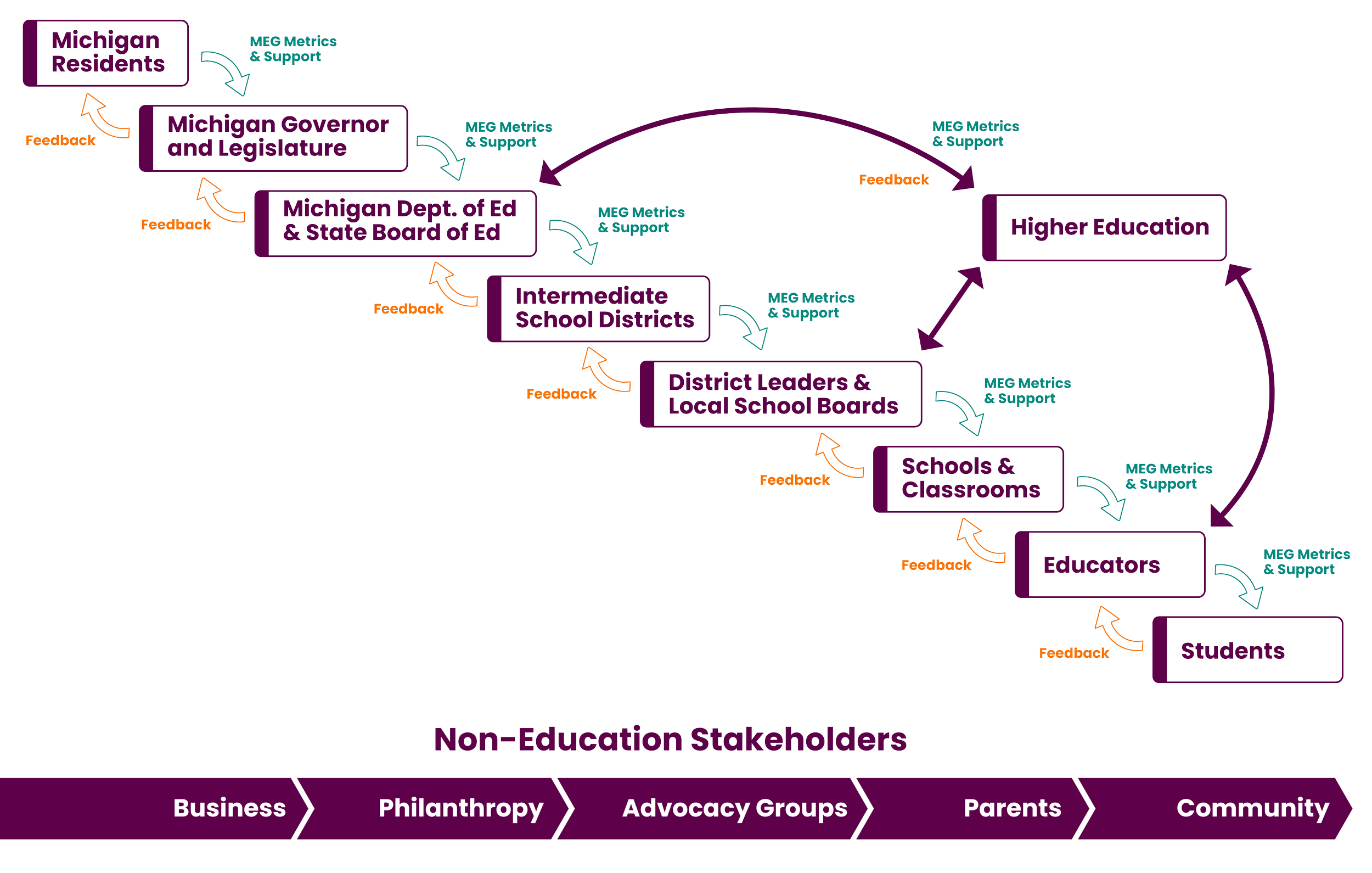
Statewide reciprocal accountability means everyone in Michigan's education system shares responsibility for student success - from state government to educators, families, and businesses. The system aligns with MEG competencies and metrics at each level. This approach connects state standards to classroom teaching while accurately measuring what works.
The MEG provides help and resources needed for all schools to succeed in preparing students.
Frequently Asked: Dispelling the Myths
The Michigan Education Guarantee (MEG) is a proposed redesign of Michigan’s high school graduation system. It builds on what works in the current Michigan Merit Curriculum (MMC) and fixes the structural barriers that prevent many students from being truly prepared for success in college, career, and life.
This guide highlights common questions and misunderstandings—and explains what the MEG can do for Michigan.
-
Yes.
MEG is grounded in extensive research on student learning, the future of work, and best practices from other states and countries. A full research summary is available in Why Michigan Needs the Michigan Education Guarantee.
-
Yes and no.
While the MMC technically allows flexibility, most districts don’t implement it that way. Two major reasons:
Misunderstanding of requirements: Many educators still believe the law requires specific course titles instead of focusing on learning goals.
Structural barriers: Funding rules (pupil accounting) and teacher certification systems reinforce a rigid “seat‑time” model, even when the law doesn’t require it.
The MEG is different:
It centers career‑focused learning for every student, not just those in CTE programs.
It aligns graduation expectations with how students actually learn and how modern career pathways unfold.
-
No.
In fact, the MEG is designed specifically to raise rigor and opportunity for all students.
Key guardrails include:
Annual parent/guardian review of each student’s Education Development Plan.
State monitoring of outcomes, with annual reviews by the Graduation Standard Oversight Committee.
A full evaluation every five years to identify inequities and fix them.
Unlike the current system—where rigor varies widely by district—the MEG builds transparency and equity into the structure itself.
-
Yes.
Some things are working, such as the MMC’s effort to raise academic expectations. But small adjustments aren’t enough.
Challenges with the current system:
A diploma mostly certifies seat time, not mastery of skills.
Schools are locked into outdated models because of accounting and certification rules.
Career-connected learning is not guaranteed for all students.
The MEG keeps what works, removes what doesn’t, and creates a system that prepares every student for a rapidly changing world.
-
You’re right—this cannot succeed without both.
The MEG:
Sets the statewide vision and expectations for graduation.
Requires transparency, data monitoring, and evaluation.
Establishes the foundation for aligning funding, accountability, and assessment through accompanying legislation and budget decisions.
Launch Michigan views this as a recipe, not a menu—the pieces must work together.
-
The FLC represents superintendent leaders already shifting toward more personalized, competency-based learning. Their experience and lessons helped shape the MEG from the start. They are early adopters demonstrating what these ideas look like in real classrooms.
-
These details are being actively developed with partners across K–12, higher education, workforce sectors, and state leadership. More FAQs will be added as that work continues.
Join the fight for our future

A re-release of Launch Michigan’s March 2026 Webinar, with some adjustments to fit the podcast format.
NOTE: Elements of the MEG may change or develop over time.